1. What Is an Energy Audit
Under Law No. 50/2010/QH12 on Economical and Efficient Use of Energy, an energy audit is defined as the activity of measuring, analyzing, calculating, and evaluating energy consumption in order to determine energy-saving potential and propose solutions for the economical and efficient use of energy at an energy-using facility.
Put more simply: it is a “health check-up” for the entire energy system of a plant or building. The audit team conducts an on-site survey, measures energy flows (electricity, steam, compressed air, heat, fuel, etc.), and compares them against actual output or usable capacity to identify three core findings:
-
How energy is being consumed, and where consumption is highest
-
Where energy is being wasted, and by how much
-
What solutions can address the waste, along with the required capital investment and payback period
2. Objectives and Specific Benefits
A properly conducted energy audit delivers far more than a compliance report. Specifically:
-
Immediate, visible cost savings: most audits identify a set of “quick-win” measures — operational adjustments, maintenance scheduling, equipment settings — that can be implemented almost immediately without major capital investment.
-
A clear basis for investment decisions: rather than replacing equipment based on intuition or supplier recommendations, businesses gain concrete data to prioritize investment in the items that deliver the highest savings and the shortest payback period.
-
Genuine regulatory compliance: submitting reports on time to the Department of Industry and Trade (DOIT), avoiding the risk of penalties during inspections.
-
Reduced emissions, supporting environmental targets: energy savings translate directly into lower greenhouse gas emissions — a factor of growing importance in sustainability reporting.
-
Competitive advantage with partners and customers: an audit report is a concrete, data-backed document that is far easier to present to international partners than vague commitments to “save energy.”
3. Two Levels of Energy Audit
Not every business needs an in-depth, costly audit from the outset. Understanding the two levels below will help businesses choose the level that best fits their budget and objectives:
For SMEs undertaking an audit for the first time, the most cost-effective approach is usually to start with a preliminary audit to identify “hot spots,” then invest in a detailed audit focused specifically on those areas.
4. Who Is Legally Required to Conduct an Energy Audit?
This is a point many SMEs are not fully aware of. Under Decree No. 21/2011/ND-CP (detailing the Law on Economical and Efficient Use of Energy No. 50/2010/QH12), an energy audit is a mandatory obligation for key energy-consuming facilities:
.jpg)
TOE (tonne of oil equivalent) is a common conversion unit used to express different forms of energy (electricity, coal, gasoline, oil, gas, etc.) on a single scale. If a business is unsure whether it falls under the mandatory category, the fastest way to check is to convert its total electricity and fuel consumption for the most recent year into TOE for comparison.
5. What Does the Energy Audit Process Look Like?
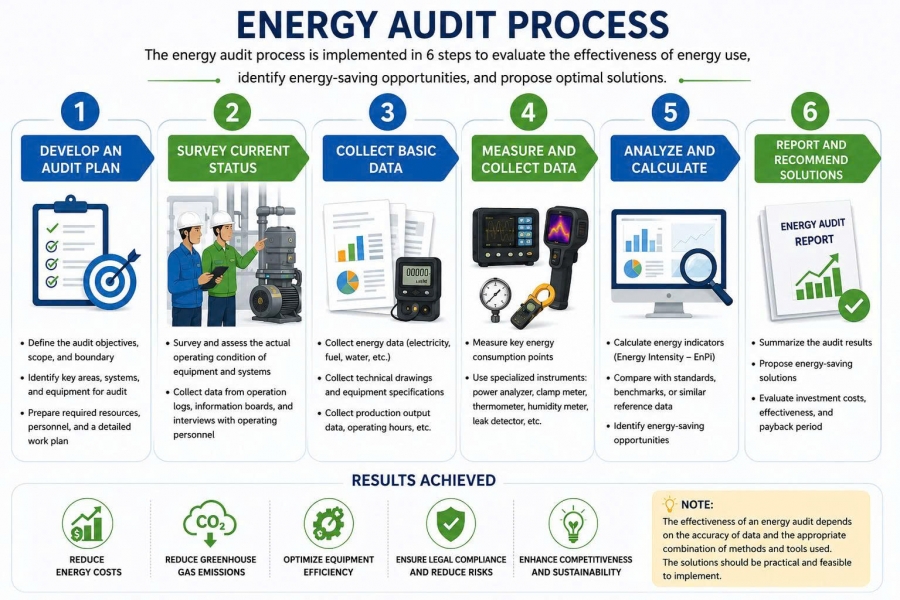
To help businesses understand what to expect and coordinate effectively with the audit provider, the process typically follows six steps:
Step 1 - Audit planning: define objectives and scope, divide the areas/departments to be surveyed, list the required measuring equipment, and assemble the audit team.
Step 2 - Preliminary site survey: the audit team directly observes actual operating conditions of the production line and equipment systems, and consults with the operations team to understand the process.
Step 3 - Baseline data collection: compiling energy bills, operating logs, and equipment technical specifications.
Step 4 - Detailed measurement: using specialized measuring instruments (power meters, thermal imaging cameras, gas analyzers, flow meters, etc.) at the key consumption points identified.
Step 5 - Analysis and calculation: determining the energy performance index for each area, benchmarking against industry standards or comparable equipment, and pinpointing specific savings opportunities.
Step 6 - Reporting and recommended actions: presenting the findings together with specific improvement solutions, estimated investment costs, expected savings, and payback period for each item.
The actual duration depends on the scale and level of the audit — a basic audit can be completed within a few days, while a detailed audit for a large plant may take several weeks to gather sufficient measurement data.
6. What Should Businesses Prepare Before the Audit Team Arrives?
How well a business prepares directly affects the quality and speed of the audit. Items worth preparing in advance include:
-
Electricity and fuel bills (gasoline, diesel, coal, gas, etc.).
-
Plant/building layout drawings, and diagrams of the electrical, steam, and compressed air systems.
-
An inventory of major energy-consuming equipment, including rated capacity and year of manufacture.
-
Output or usable-capacity data corresponding to the period of energy consumption (needed to calculate the performance index).
-
The most recent equipment maintenance schedule.
-
Assigning operations staff who are familiar with the facility to accompany the audit team during the survey.
Preparing these items thoroughly not only shortens the audit timeline but also makes the final report more accurate and reflective of actual operating conditions.
7. What to Do After the Audit?
The audit itself is only the first step — the real value lies in implementation. Businesses should:
-
Prioritize quick-win solutions first — these typically require little to no capital investment yet deliver fast savings, building momentum for subsequent steps.
-
Develop a phased investment plan for solutions that require larger capital, based on the priorities set out in the report.
-
Track post-implementation results, comparing actual consumption before and after each solution is applied to confirm that the expected savings are actually achieved.
-
Re-audit periodically or whenever there is a major change to the production line, in order to update the overall picture of energy consumption.
For businesses seeking more structured, long-term energy management, this is also a good point to consider building a formal energy management system (such as one aligned with ISO 50001) — in which case, data from previous audits will provide a foundation that makes the process faster and less costly.
8. Common Mistakes
Conducting an audit purely to satisfy a reporting obligation, then leaving the report to gather dust without implementing any of its recommendations — turning the cost of the audit into pure waste.
Selecting an audit provider based solely on the lowest price, which often results in a superficial report lacking quantitative data and insufficient grounds for investment decisions.
Failing to prepare adequate data before the audit, forcing the audit team to rely on estimates rather than precise measurements, which reduces the reliability of the results.
Not tracking results after implementation, leaving the business unable to confirm whether the applied solutions actually performed as the report projected.
Waiting until close to the reporting deadline to start the audit, leaving insufficient time to gather the required 12 months of data and compromising the quality of the report.
An energy audit is not merely an administrative procedure — it is a practical tool that helps a business see a clear picture of its own energy consumption, enabling investment decisions that are well-targeted and well-timed. For SMEs, it is typically the most sensible starting point on the journey toward energy management, before considering more complex and costly management systems. If your business is unsure whether it falls under the mandatory audit requirement, or would like a preliminary estimate of potential savings before committing to an investment, a conversation with an experienced energy audit provider can give you a clear answer in a short time.
As one of the pioneers in the field of energy auditing, with experience conducting energy audits for numerous plants, ENERVI partners with businesses from the initial survey stage all the way through to the actual implementation of savings solutions — rather than stopping at a report that simply gets filed away:
-
Measurement with specialized equipment, carried out on-site by an experienced technical team, ensuring the data accurately reflects actual operating conditions.
-
Reports with clear investment justification: every proposed solution comes with an estimated cost, expected savings, and payback period, enabling management to make fast, well-informed decisions.
-
Support at the right audit level, from preliminary surveys to detailed audits that meet the mandatory reporting obligations under the law.
-
Ongoing support after the audit: helping businesses track implementation results and plan periodic re-audits as needed.
Contact ENERVI today for a free consultation and a customized energy audit quote suited to the scale of your business.
Phone: Nguyen Xuan Quang - 0916 127 468. Email: nxquang@enervi.vn
#energyaudit#nangluongenervi









.jpg)