Many businesses begin implementing ISO 50001 with clear objectives: improving energy efficiency, controlling operating costs, and gradually building an ongoing energy management system. They may have already formed an implementation team, conducted training, carried out a current-state assessment, and run an energy audit.
Yet after the initial kickoff phase, a fair number of these projects gradually stall, drag on far longer than planned, or fail to reach certification as originally intended.
In practice, these difficulties usually don't stem from ISO 50001 being an overly complex standard — they come down to how the business organizes and sustains the implementation process. This is especially true for manufacturers, where energy use is tightly bound up with equipment, processes, and production schedules; an energy management system can only run effectively when it's built to match real operating conditions.
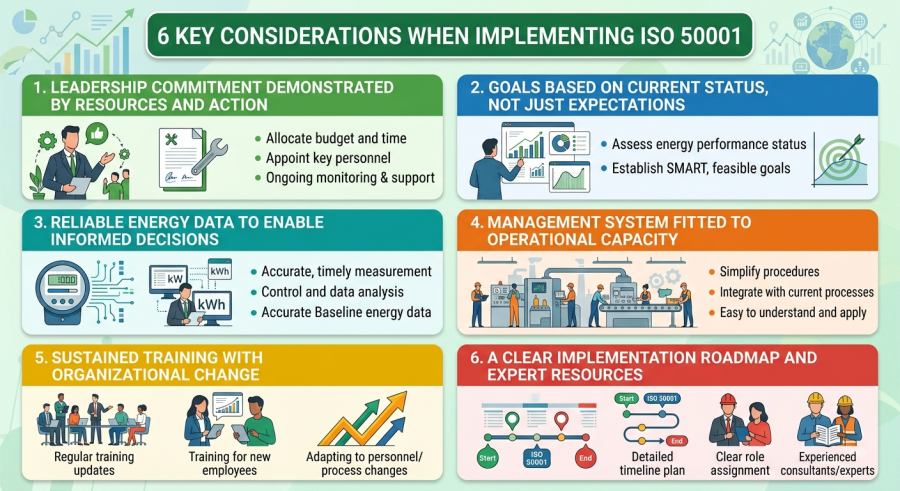
Below are six factors businesses should pay particular attention to when implementing ISO 50001.
1. Leadership commitment needs to show up as resources and action, not just policy
Leadership involvement is one of the foundational conditions for an energy management system to run effectively. In practice, however, some businesses still treat ISO 50001 as a technical project and hand most of the responsibility to a single staff member or technical team.
This approach can become a bottleneck once the project needs decisions that go beyond what the energy team can authorize on its own — approving investment in metering equipment, allocating resources, adjusting operating practices, or coordinating across departments.
Leadership commitment, then, shouldn't stop at issuing an energy policy. Businesses need to clearly define the responsibilities, authority, and resources given to the implementation team, and keep progress and results under regular review as part of their normal governance rhythm.
A good starting point: clearly define the roles of leadership and the energy team, allocate appropriate resources, and set up a regular reporting and review mechanism.
2. Targets should be based on current conditions, not just expectations
After looking at successful ISO 50001 case studies, a business can easily be tempted to set very ambitious savings targets of its own. But the degree of improvement achievable depends on many factors — existing equipment condition, production processes, data quality, level of investment, and the practical feasibility of implementing solutions.
A target that doesn't match real conditions can put unnecessary pressure on the implementation team. When early results fall short of expectations, the project risks being judged as ineffective.
Rather than fixating on a specific savings percentage right away, the early phase should prioritize building a reliable energy management foundation: establishing the energy baseline, identifying the factors that influence consumption, developing appropriate EnPIs, and identifying genuinely feasible improvement opportunities.
Once the system has solid data and is running stably, the business will be in a much better position to set improvement targets for the following phases.
3. Energy data needs to be reliable enough to support real decisions
Data is the foundation of an effective energy management system. Yet this is also one of the most common pain points at manufacturing plants — particularly where energy consumption is only tracked at the overall facility level.
Without data broken down by area, production line, or major consuming system, a business will struggle to identify its significant energy uses, build a credible energy baseline, or evaluate how much improvement a given solution actually delivered.
This doesn't mean a business has to invest in comprehensive metering right away. A more effective approach is to identify the areas or systems with the most significant energy consumption and prioritize adding metering where it will yield the most valuable information.
The goal isn't to "measure as much as possible" — it's to have data reliable enough to understand, control, and improve energy performance.
4. The management system needs to match real operating capacity
An energy management system is only effective if it can actually be sustained in day-to-day operations.
During implementation, a business may build out numerous procedures, forms, and control requirements in an effort to fully cover every element of the system. But if the system ends up more complex than the plant's scale, resources, and actual way of operating can support, updating data and following procedures becomes an administrative burden.
At that point, the system risks existing mainly on paper rather than becoming part of how the plant actually runs.
Businesses should build their documentation on the principle of "enough to control, easy to follow, sustainable to maintain." Procedures and forms should be designed around how the business genuinely operates, with room to expand as the system matures.
5. Training needs to keep pace with organizational change
Training tends to get plenty of attention in the early stages of an ISO 50001 project, but a system's effectiveness can't be sustained by a single initial training program alone.
In a production environment, staff turn over, operating procedures get adjusted, and new equipment is continually brought online. If energy management knowledge isn't kept up to date, requirements and good practices can gradually be forgotten.
Training should therefore be built into the business's regular training system — including periodic awareness refreshers and training for new hires or for roles with significant influence over energy performance.
More importantly, operators need to understand why a requirement exists and how it affects energy performance, not just what they're supposed to do.
6. Have a clear roadmap and the right technical resources
ISO 50001 combines management-system requirements with technical questions specific to energy performance. Implementing it effectively requires a business to understand its energy situation, its operating data, its improvement opportunities, and how to build a management system capable of lasting well beyond initial certification — all at the same time.
For businesses implementing ISO 50001 for the first time, doing everything entirely in-house can create real difficulties — from defining scope and analyzing data to building the baseline and EnPIs, setting up procedures, assigning responsibilities, and preparing for the certification audit.
An experienced consulting partner can support the business throughout this process — assessing current conditions, building the roadmap, delivering training, helping set up the system, and preparing the business for certification.
That said, the goal of consulting shouldn't be to build the system for the business. A sustainable ISO 50001 system needs to be owned by the business itself, capable of running independently once the project concludes.
Starting the right way is what makes it last
Every business differs in scale, technology, energy makeup, and management capacity — so there's no single ISO 50001 implementation roadmap that fits everyone.
What matters is accurately assessing current conditions, choosing the right scope, building a realistic roadmap, and allocating proportionate resources from the very start.
We help businesses assess their current state, build an ISO 50001 implementation roadmap, develop their energy management system, train their teams, and stay engaged through preparation for the certification audit. If your business is considering ISO 50001, or a project is already underway but running into difficulties,
contact with us to discuss a roadmap suited to your actual operating conditions.

Nguyen Xuan Quang – 0916 127 468 |

nxquang@enervi.vn
Fanpage:
Năng lượng Enervi
#ISO50001 #EnergyManagement #EnergySavings #ISOConsulting #nangluongenervi