The challenge facing Vietnamese manufacturing businesses in 2026. If you work in manufacturing, you've certainly heard about ESG in meetings with international customers. Partners from the EU, the US, and Japan are demanding that suppliers provide data on carbon emissions. Banks are starting to ask about ESG scores before approving loans. If your business doesn't have answers, you risk losing orders or missing out on preferential financing.
ESG – short for Environmental, Social, and Governance – is no longer just a concern for large corporations. It's now filtering down to tier 2 and tier 3 suppliers in Vietnam.
So the question is: How can you prove that your business is performing well on ESG in a structured, transparent way – rather than just making vague claims?
➡ The answer lies in a standard that manufacturers are already familiar with – ISO 50001 (Energy Management System).
What is ISO 50001? More than just an energy-saving certificate
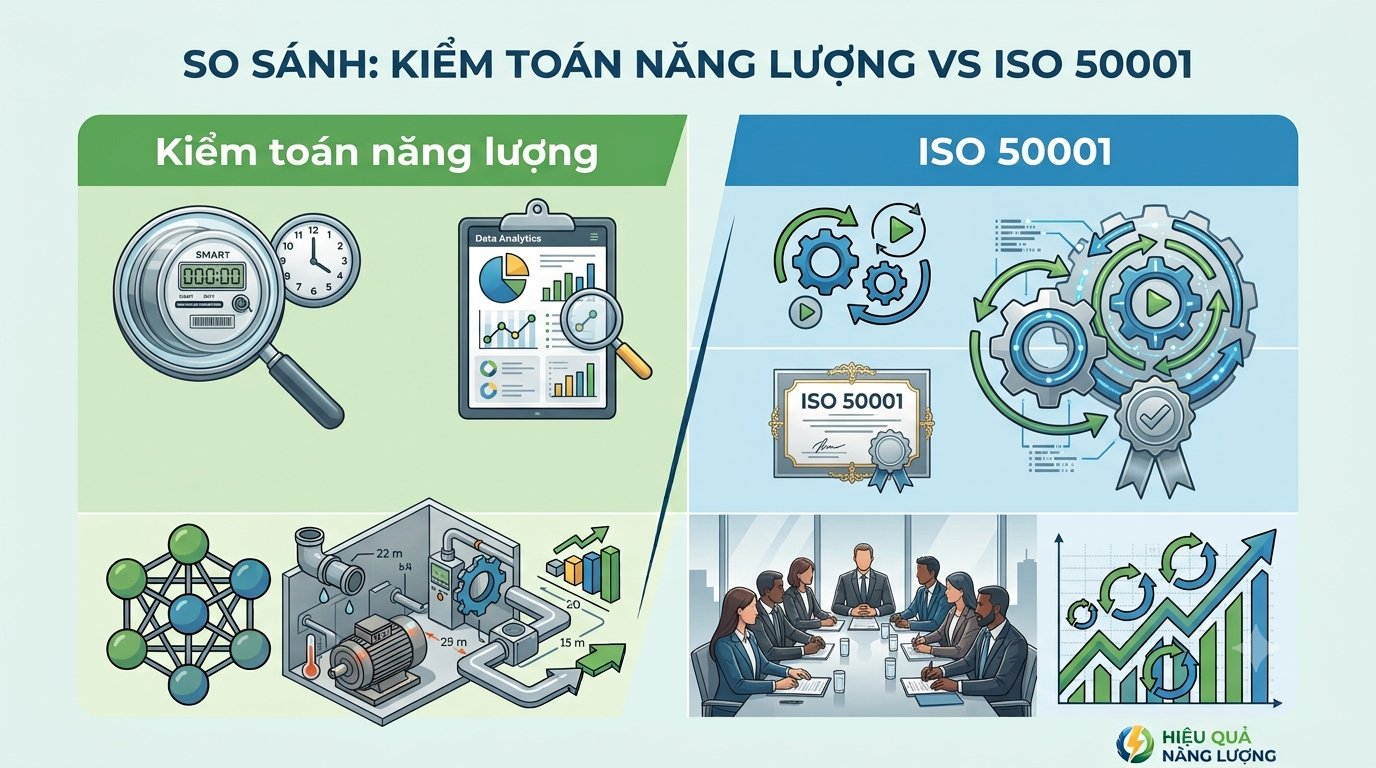
Many people mistakenly think ISO 50001 is just an energy-saving program. In reality, it's a full data management system for energy consumption. Specifically, ISO 50001 requires businesses to:
- Accurately measure energy usage for each stage of production
- Establish performance indicators (EnPIs) to compare across months and years
- Set specific improvement targets and track progress regularly
- Continuously improve through the Plan – Do – Check – Act (PDCA) cycle
In simple terms: Instead of saying "we saved a bit of electricity," ISO 50001 lets you say "we reduced our energy intensity by 12% over 3 years, and here are the actual measurement data to prove it."
This is what sets it apart. And this is exactly what ESG reports need.
How does ISO 50001 support ESG strategy?
1. Environmental (E) – The clearest benefit
The link between energy and carbon emissions is straightforward: the more fossil fuels or electricity a business uses, the more CO₂ it generates. The better you manage your energy, the lower your emissions.
With ISO 50001, businesses can:
- Quantify exactly how much energy has been reduced
- Calculate the corresponding CO₂ reduction
- Provide data to report to customers, investors, and banks
This is what convinces international partners. They no longer have to rely on rough estimates – they can see real data coming from your management system.
2. Social (S) – Less visible but real
Who says ISO 50001 only relates to machinery? It also impacts people:
- Workers in factories benefit from better-controlled conditions – temperature, ventilation, and safety – especially in areas with boilers and compressed air systems.
- Local communities benefit from reduced emissions and noise pollution.
Not everyone notices these social impacts, but they are a legitimate part of ESG reporting that businesses should highlight.
3. Governance (G) – Making data transparent
One of the biggest barriers to ESG reporting is the lack of data. Many businesses report based on estimates or aggregated figures with no solid foundation. When auditors come knocking, there's nothing to back it up.
ISO 50001 solves this by:
- Creating a structured data system with proper documentation
- Requiring regular internal audits and third-party certification
- Forcing leadership to make decisions based on data, not gut feeling
This is exactly what good governance – the "G" in ESG – looks like.
Practical benefits your business will gain
✅ Meeting international customer requirements
Major corporations like Apple, Nike, and Unilever are requiring their suppliers to have energy management systems in place. Without one, you risk being dropped from their supplier list.
✅ Cutting production costs
Every unit of energy saved is money saved. Businesses that adopt ISO 50001 typically save between 10–30% on energy costs.
✅ Easier access to financing
Both international and domestic banks are offering green credit programs with preferential interest rates for businesses with environment- and energy-related certifications.
✅ Avoiding greenwashing risks
When you claim to be environmentally friendly but can't back it up with data, you're vulnerable to exposure. ISO 50001 provides actual data to protect your business from such accusations.
✅ Being ready for new regulations
The EU has already introduced CBAM (Carbon Border Adjustment Mechanism), requiring imported products to disclose their carbon footprint. Businesses with robust energy management systems will find compliance much easier. At the end of 2024, Vietnam's Prime Minister issued Directive No. 33/CT-TTg on carbon market development – many industries will be subject to emissions controls before 2028.
Already have ISO 9001/14001? Adding ISO 50001 won't be difficult
Many Vietnamese businesses already have ISO 9001 (Quality Management) or ISO 14001 (Environmental Management). The good news is that ISO 50001 is built on a structure compatible with both of these standards.
What this means: if your business is already familiar with documentation, internal audits, and management reviews under ISO 9001/14001, adding ISO 50001 is simply an expansion of scope – not starting from scratch.
This is an advantage many businesses haven't recognized yet.
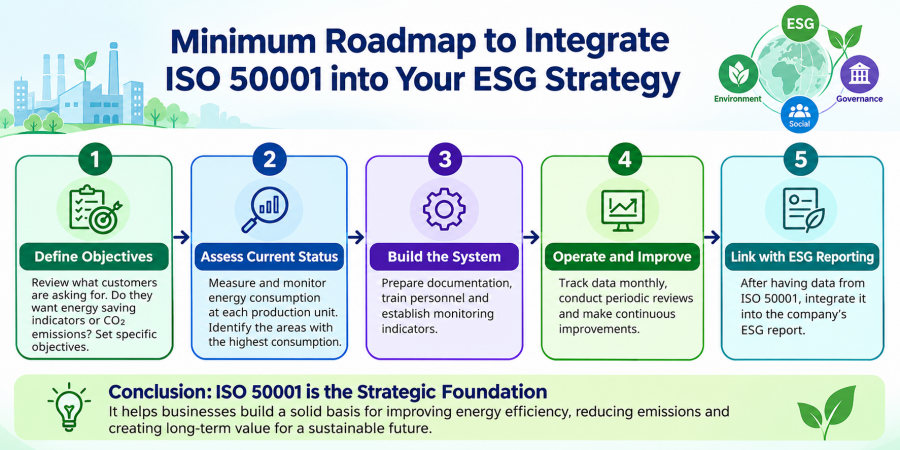
A minimal roadmap for integrating ISO 50001 into your ESG strategy
Step Action
ESG is changing the way businesses are valued and evaluated. For Vietnamese manufacturing companies, ISO 50001 is not just a certificate to hang on the wall. It's a way to proactively adapt to new trends – rather than reactively scrambling to catch up.
If 2025 was the year businesses started hearing about ESG, 2026 is the year partners will start demanding concrete evidence.
ISO 50001 provides that evidence.
Are you considering implementing ISO 50001 to meet ESG requirements for your business?
Contact us for a consultation on a roadmap tailored to your business's specific situation – including current status assessment, planning, and support throughout the implementation process.
Contact: Nguyen Xuan Quang - 0916 127 468 | Email: nxquang@enervi.vn
Fanpage:
Năng lượng Enervi
#ISO50001 #ESG #nangluongenervi