ENERGY AUDIT PROGRAM FOR INDUSTRIAL FACTORIES
Within the framework of implementing the National Program on Energy Efficiency and Conservation for the period 2019-2030 (VNEEP3); The Ministry of Industry and Trade and relevant agencies have had initial activities and policies towards the goal of saving 5-7% of total national energy consumption in the period up to 2025 and reaching 8-10% in the entire period from 2019 to 2030. And further, bringing the economy to zero net emissions by 2050.
According to energy experts, Energy Audit is an inevitable trend that all manufacturing enterprises must meet in the coming time.
I./ REGULATIONS OF THE MINISTRY OF INDUSTRY AND TRADE ON ENERGY AUDIT REPORTS AT FACILITIES
On September 29, 2020, the Ministry of Industry and Trade issued Circular 25/2020/TT-BCT regulating the preparation of plans and reports on the implementation of plans for economical and efficient energy use; conducting energy audits.
Key energy-using establishments are industrial and agricultural production establishments, transportation units with a total energy consumption in 01 year converted into equivalent tons of oil from one thousand tons or more (1,000 TOE); construction works used as headquarters, offices, houses; educational, medical, entertainment, physical training and sports establishments; hotels, supermarkets, restaurants, stores with a total energy consumption in 01 year converted into equivalent tons of oil from 500 TOE.
Accordingly, the regulations on energy audit for key energy-using establishments are as follows:
- The establishment is responsible for conducting mandatory energy audits every 3 years. The steps for conducting energy audits and the contents of the establishment's energy audit report are specified in Appendix III issued with Circular 25/2020/TT-BCT.
- The energy audit result is an energy audit report, including survey data, measurements, data collection on the establishment's energy usage situation, analysis, calculation and assessment of energy efficiency, assessment of energy saving potential, proposal of energy saving solutions, analysis of investment efficiency for proposed energy saving solutions for the establishment to select and implement.
- Within 30 days after conducting the energy audit, the establishment is responsible for sending a written energy audit report to the local Department of Industry and Trade.
- Within 30 days from the date of receipt of the energy audit report, the Department of Industry and Trade is responsible for receiving, approving or providing comments, requesting corrections and supplements according to the content specified in Appendix 4 of Circular 25/2020/TT-BCT. The facility is responsible for completing the energy audit report and sending it back in writing to the Department of Industry and Trade within 60 days after receiving comments, requests for corrections and supplements from the Department of Industry and Trade.
- For new facilities listed in the list of key energy-using facilities according to the Prime Minister's Decision, within one year from the date of issuance of the Prime Minister's Decision, the facility is responsible for completing the energy audit report and sending it to the Department of Industry and Trade.
Circular 25/2020/TT-BCT takes effect from November 13, 2020 and replaces Circular 09/2012/TT-BCT dated April 20, 2012.
II./ WHAT CONTENTS DOES THE ENERGY AUDIT PROGRAM INCLUDE?
An energy audit is a process of checking, surveying and analyzing energy flows for energy conservation in a building, a process, or a system to reduce the amount of energy input into the system without adversely affecting the output. In simpler terms, an energy audit is the inspection and calculation of the amount of electricity consumed by a construction, building, factory or facility, process in order to propose solutions to effectively save energy consumption.
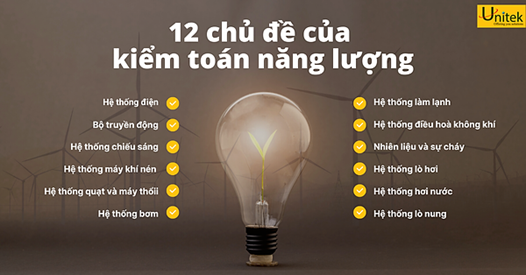
There are 12 energy efficiency assessment topics in the energy audit program; including:
1. Energy efficiency in electrical systems
2. Efficiency for motors and drives
3. Energy efficiency in lighting
4. Energy efficiency in pneumatic systems
5. Energy efficiency in fans and blowers
6. Energy efficiency for pumping systems
7. Energy efficiency for cooling systems
8. Energy efficiency for air conditioning systems
9. Fuel and combustion
10. Energy efficiency in boilers
11. Energy efficiency for steam systems
12. Energy efficiency for furnaces
III./ BENEFITS OF ENERGY AUDIT
Energy audits bring many benefits to factories, including:
• Initial implementation of energy saving projects, provided that the implementation process is serious and scientific.
• A premise to help facilities and businesses carry out energy saving activities
• Ensure a sustainable energy management system in the enterprise.
• Comply with the law according to the provisions in legal documents as well as related decrees and circulars.
• Save energy costs, save prices, improve competitiveness.
• Reduce pollution, emissions, ensure quality of life.
• Ensure national energy security.