As energy prices continue to rise and sustainability requirements grow ever stricter, effective energy management is no longer a "nice to have" — it has become essential to the competitiveness of manufacturing businesses. ISO 50001, the international standard for Energy Management Systems (EnMS), is the tool that helps businesses turn energy saving from scattered, one-off efforts into a systematic, measurable, and lasting management process.
What Is ISO 50001?
ISO 50001 is an international standard issued by the International Organization for Standardization (ISO) that provides organizations with guidance for building and implementing an energy management system. Through this standard, industrial facilities can embed energy efficiency objectives directly into their operations and management — from collecting and monitoring energy data to evaluating and adjusting energy-consuming activities. This approach not only helps improve energy performance but also optimizes production operations and encourages the adoption of appropriate technology solutions.

For manufacturing businesses, adopting and achieving ISO 50001 certification can lay the foundation for controlling and reducing energy consumption through both improved operating practices and better management. At the same time, a management system built to the standard can make it easier for a business to access and deploy more energy-efficient technologies. Because it can be applied across many types of organizations, ISO 50001 is especially meaningful for manufacturing facilities, where energy costs, operational efficiency, and competitiveness are closely intertwined.
Core Benefits for Manufacturing Businesses
1. Sustainable energy cost savings
Energy costs make up a significant share of manufacturing operations. For plants that consume large amounts of electricity, fuel, and steam, reducing consumption by even a few percentage points each year can generate substantial savings over the long term. ISO 50001 requires businesses to establish an energy baseline and appropriate EnPIs (Energy Performance Indicators), which makes it possible to measure, verify, and track savings year over year. Notably, the higher a plant's energy consumption, the greater its absolute savings potential.
2. Improved operational performance
Building an Energy Management System (EnMS) requires a business to review its entire production process, which in turn helps identify underperforming equipment, suboptimal operating schedules, or hidden sources of energy loss such as compressed-air leaks and heat loss. Through energy audits and ongoing monitoring, businesses can pinpoint their most significant energy uses and build a data-driven improvement roadmap, rather than searching for savings opportunities in an ad hoc way.
3. Meeting regulatory and supply-chain requirements
Export markets and multinational corporations are increasingly focused on energy efficiency and emissions reduction across their supply chains. ISO 50001 certification is internationally recognized, objective proof that helps businesses better meet supplier evaluation criteria, strengthen their competitiveness, and open up more partnership opportunities. At the same time, proactively adopting the standard helps energy-intensive businesses in Vietnam adapt more readily to increasingly stringent regulatory requirements.
4. Reduced greenhouse gas emissions and support for ESG goals
ISO 50001 helps businesses use energy more efficiently, thereby reducing both energy consumption and greenhouse gas emissions. Achieving certification also demonstrates a company's commitment to sustainable development, helping build a green brand image, enhance reputation, and meet ESG criteria — which can also be an advantage in attracting investors and expanding partnerships with international partners.
5. Continuous improvement that doesn't depend on individuals
ISO 50001 embeds energy management into a business's systems and processes, so that energy savings are sustained even when responsible staff change. The standard requires clearly assigned responsibilities, periodic evaluation, management review, and staff awareness training. As a result, energy-saving activities become part of everyday operations and continue to improve over time, rather than depending on a handful of key individuals.
ISO 50001 Energy Management Success Stories from Manufacturing Businesses
Vinamilk
Vinamilk is one of the pioneering manufacturers in Vietnam to adopt ISO 50001, having maintained the system for more than a decade. Since 2013, 100% of the facilities in Vinamilk's production network — now comprising 14 factories and 16 farms in Vietnam and abroad — have implemented an energy management system under this standard. Sustaining the system goes well beyond initial certification: according to the company's energy management representative, all factory staff receive awareness training on the energy management system, and those directly involved must attend refresher training at least once a year to update their knowledge and maintain the system's effectiveness — in line with ISO 50001's principle of continual improvement. Specific results the company has achieved through the system include:
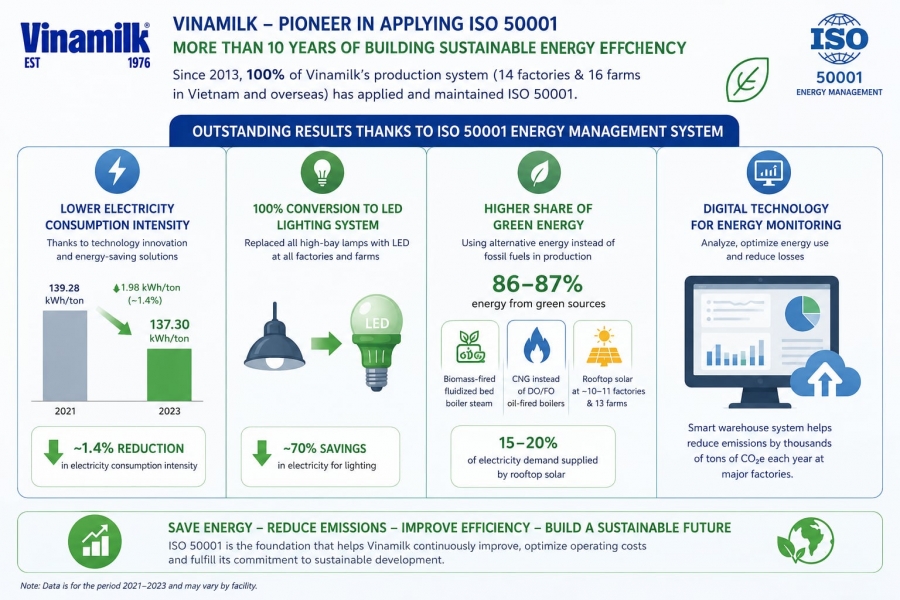
- Lower electricity consumption per ton of product: down from 139.28 kWh/ton (2021) to 137.30 kWh/ton (2023), thanks to technology upgrades and energy-saving measures identified through the energy management system.
- 100% conversion to LED lighting across all factories and farms (replacing previous high-pressure sodium lamps), saving around 70% of electricity consumption for lighting alone.
- A rising share of green energy: roughly 86–87% of the energy Vinamilk uses in production now comes from sources that replace fossil fuels — including saturated steam from biomass-fired fluidized-bed boilers (used at facilities with sufficient land area), CNG replacing DO/FO-fired boilers (at facilities with limited space), and rooftop solar power installed at around 10–11 factories and 13 farms, meeting 15–20% of electricity demand at those sites.
- Digital technology for energy monitoring: the company has deployed energy monitoring software to analyze and optimize consumption and reduce losses, along with smart warehouse systems that cut CO2e emissions by thousands of tons per year at several large facilities.
VIPACO
Vietnam Packaging Application Investment Co., Ltd. (VIPACO) faced a number of challenges specific to the packaging industry on its way to ISO 50001 certification — an industry where production equipment requires frequent heating during operation, making energy management and savings considerably more complex than in many other sectors. To address this, the company rolled out a series of improvement measures, including optimizing machinery layout and strengthening energy management practices within the ISO 50001 framework.
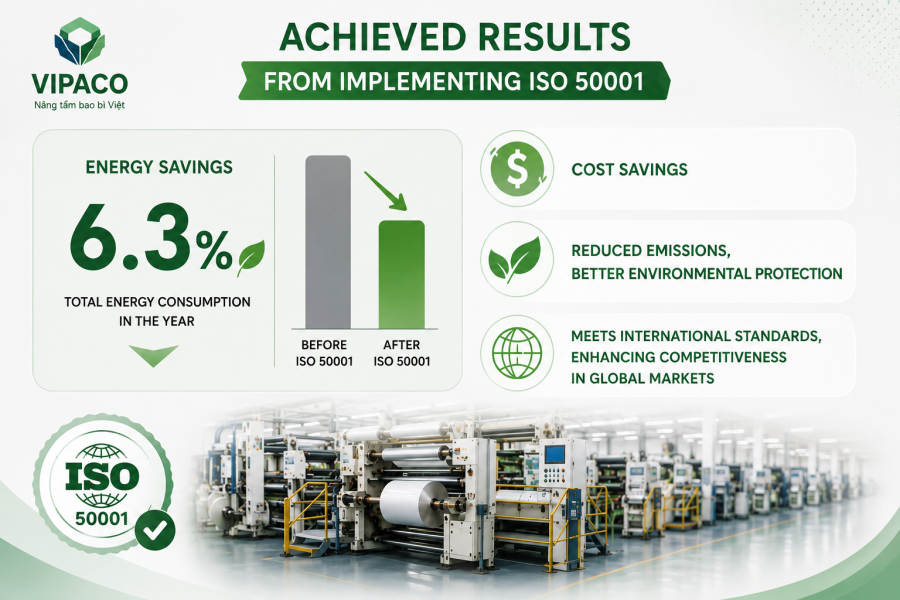
As a result, VIPACO recorded savings of about 6.3% of its total annual energy consumption — an impressive figure for the packaging manufacturing sector, which is inherently energy-intensive. Beyond cutting costs, this achievement has also helped VIPACO meet demanding international environmental standards, boosting its reputation and competitiveness in the global market.
These examples show that the effectiveness of ISO 50001 is not confined to theory or to cases abroad — it has been proven in practice at manufacturing businesses operating right here in Vietnam, with the degree of savings varying considerably depending on the industry and each plant's starting point.
Where Should Vietnamese Manufacturers Start?
For manufacturing businesses in Vietnam, energy costs make up a growing share of product costs, while pressure from international customers around environmental standards is also increasing. Implementing ISO 50001 typically follows these steps:
1. Assess current energy consumption and identify significant energy uses
This is the mandatory starting point: a business needs to review its entire production line, equipment, and facility areas to identify where the largest energy consumers are and where the greatest improvement potential lies — so resources can be focused where they matter most, rather than spread thin.
2. Establish an energy baseline and appropriate EnPIs
The baseline is the "reference point" for comparing savings performance year over year, while EnPIs (for example, kWh per ton of product, or kWh per unit of revenue) allow a business to measure energy performance objectively and verifiably, rather than relying on subjective judgment.
3. Develop an energy policy, objectives, and action plan
Leadership must formally commit, in writing, to a direction for energy management, set specific targets (for example, reducing electricity consumption by X% over Y years), and clearly assign responsibility to relevant departments and individuals.
4. Train staff and operators on energy awareness
Because most energy-saving opportunities come from day-to-day operating behavior, training should not be a one-time event at rollout but should be repeated periodically (typically at least once a year) to maintain and update knowledge across all relevant staff — as Vinamilk's own experience demonstrates.
5. Monitor, measure, and continually improve
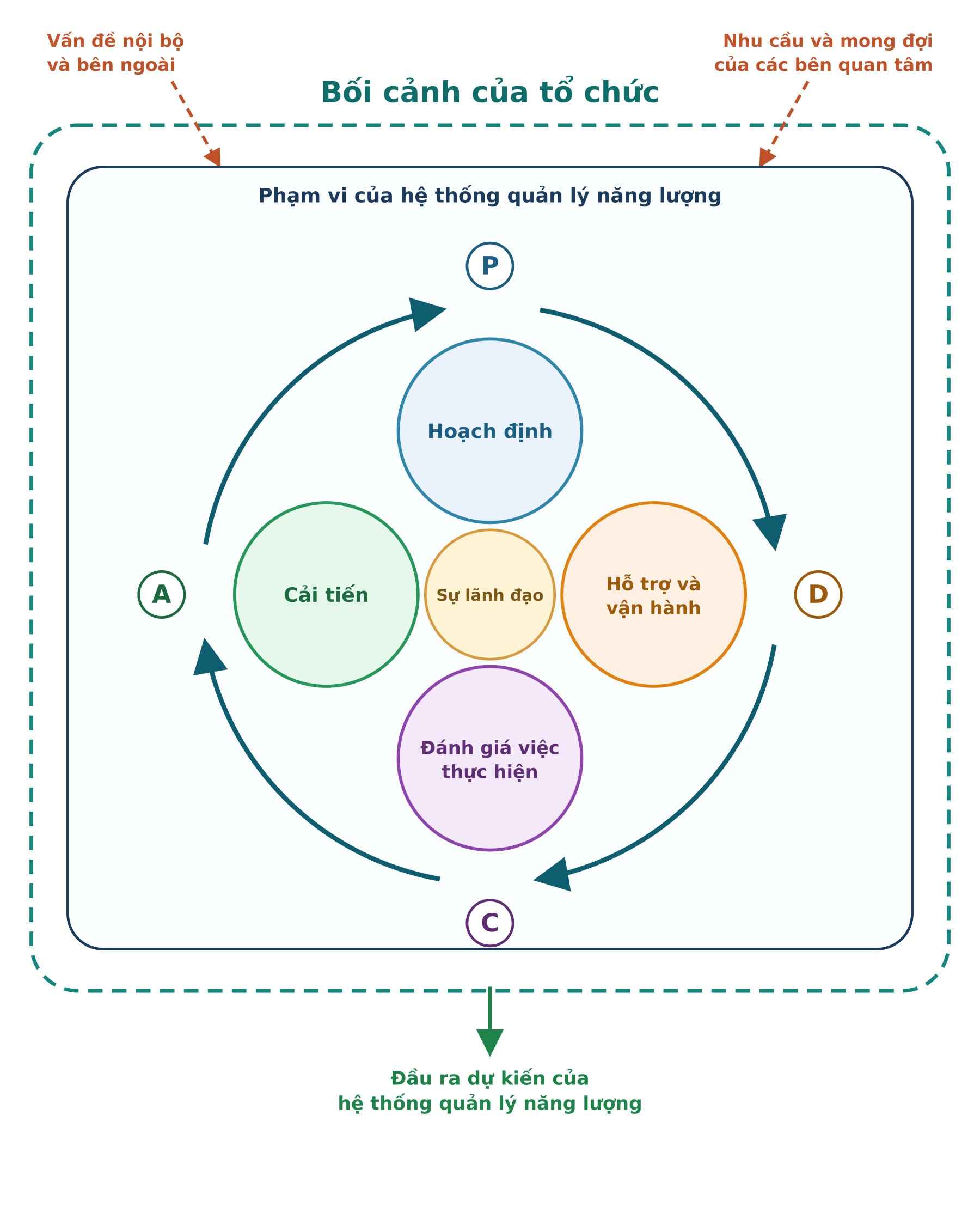
A business needs to set up regular energy data tracking (which can be paired with energy monitoring software), conduct periodic internal audits and management reviews, and continually adjust targets and solutions to match real-world operating conditions — in keeping with ISO 50001's Plan-Do-Check-Act approach.
6. Certification audit by an independent body
Once the energy management system has been operating stably for a sufficient period, the business undergoes a certification audit by an accredited certification body (such as QUACERT in Vietnam) to confirm that the system fully meets the standard's requirements before ISO 50001 certification is granted.
In practice, this is a process that requires coordination across multiple departments (engineering, production, finance, human resources) and typically takes anywhere from a few months to more than a year, depending on plant size. An experienced consulting partner can significantly shorten the implementation timeline at each of the steps above, help avoid common pitfalls when building the system in-house (such as setting inappropriate EnPIs or lacking reliable baseline data), and keep the certification process on schedule.
Successfully applying ISO 50001 isn't just about achieving certification — what matters more is building a system that genuinely works well, backed by a team with the capability to sustain it over the long term. These are the two core values we bring: consulting on the design and implementation of an ISO 50001 energy management system tailored to each business's specific production line, along with hands-on training for staff, engineers, and operators to ensure the system is run correctly, effectively, and sustainably long after certification.
If your business is considering adopting ISO 50001 — or already has a system in place but needs it re-evaluated and your team retrained — get in touch with us for an initial assessment and consultation.
 Hotline: Nguyen Xuan Quang - 0916 127 468 |
  nxquang@enervi.vn
Fanpage: Năng lượng Enervi
#ISO50001 #EnergyManagement #EnergySavings #ISOConsulting #nangluongenervi