According to experts, the Ministry of Industry and Trade needs to provide specific and convincing explanations about the objectives, operating mechanisms, and effectiveness of the plan to transfer EVN to the Ministry.
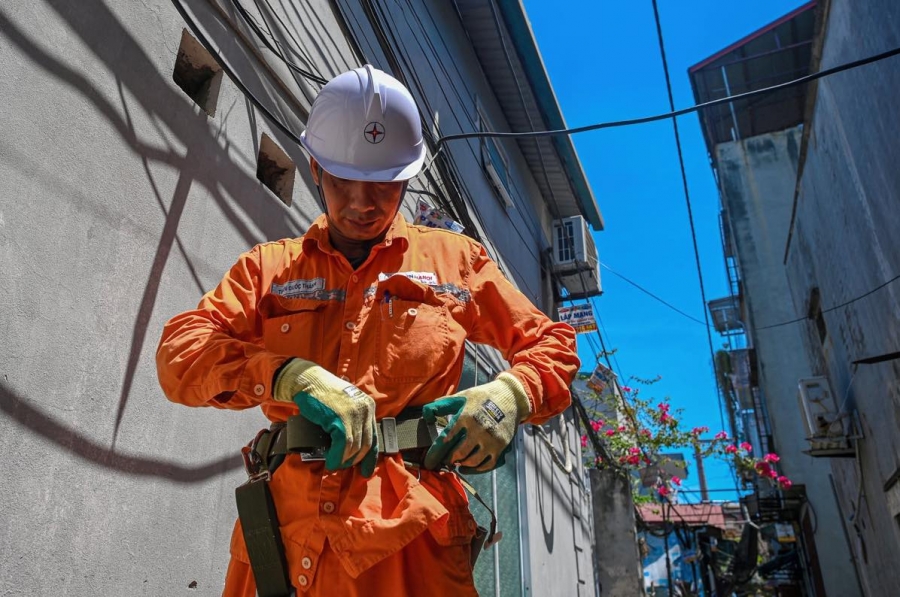 The Ministry of Industry and Trade proposes the policy of transferring EVN to the Ministry as the owner agency to have sufficient forces and resources to implement the plan after it is approved. Photo: EVN
It's not like just transferring EVN to the Ministry of Industry and Trade can remove all bottlenecks
The Ministry of Industry and Trade proposes the policy of transferring EVN to the Ministry as the owner agency to have sufficient forces and resources to implement the plan after it is approved. Photo: EVN
It's not like just transferring EVN to the Ministry of Industry and Trade can remove all bottlenecks
In a summary report on solutions to ensure electricity supply in the 2026-2030 period and adjusting Power Plan VIII, the Ministry of Industry and Trade proposed the policy of transferring Vietnam Electricity Group (EVN) to the Ministry of Industry and Trade as the owner agency to have sufficient forces and resources to implement the plan after it is approved.
Talking to Lao Dong Newspaper, Dr. Nguyen Xuan Quang - Institute of Energy Technology, Hanoi University of Science and Technology, said that if the planning agency is also the representative agency of the owner, the distance from planning to implementation can be shortened. The Ministry can quickly grasp the capacity, progress, and capital balancing capacity of EVN; conversely, EVN also responds promptly to the feasibility. However, unifying the focal point does not mean that all obstacles will be resolved.
According to Dr. Nguyen Xuan Quang, to start a power project, the project must first be in accordance with the local plan. Next are investment policy procedures, land and site clearance, then capital arrangement. These stages are located in many agencies, many levels, not just in EVN's hands. A project that is slow to clear the site, no matter which ministry EVN is directly under, the site is still slow.
Most of the increased power source capacity in the adjustment of Power Plan VIII is wind power, solar power and LNG, with a large role of the private sector. Progress depends on the price mechanism, power purchase and sale contracts, connection and capacity clearance," Dr. Nguyen Xuan Quang emphasized.
Talking to Lao Dong Newspaper, Assoc. Prof. Dr. Ngo Tri Long - Former Director of the Institute for Market and Price Research (Ministry of Finance) said that in the report, the Ministry of Industry and Trade also assessed that the project implementation in many localities is still very slow and many large power sources are at risk of not being put into operation before 2030. Therefore, the Ministry has proposed to continue to improve investment attraction policies, PPP mechanisms and electricity price mechanisms according to the market with state regulation.
The National Assembly also had to issue Resolution 253/2025/QH15, effective from March 1, 2026, introducing specific mechanisms for energy development in the 2026-2030 period, from updating planning, investing in power projects to offshore wind power and direct electricity purchase and sale. This shows that the bottleneck of the electricity industry is inter-sectoral and inter-level, which cannot be solved simply by changing the management place of EVN.
Bringing EVN to the Ministry of Industry and Trade can solve the coordination problem, but it cannot replace the reform of investment procedures, land, site clearance, electricity prices and capital mobilization. If those bottlenecks are not removed, planning still risks being very beautiful on paper but the project is slow on the ground," Assoc. Prof. Dr. Ngo Tri Long emphasized.
How will the Ministry of Industry and Trade manage and be responsible?
Regarding the proposal to transfer EVN to the Ministry of Industry and Trade, Dr. Nguyen Xuan Quang said that the Ministry needs to clearly analyze the boundaries between both state management of electricity and representing the owner of the largest enterprise in the market. In the role of state management, the Ministry needs to develop policies, plans, regulate prices and markets, and inspect and supervise. In the role of owner representative, powers are exercised according to corporate law and law on state capital, and EVN's right to self-manage production and business and shareholder rights in member companies must be respected.
Along with that, market regulation must ensure transparency and fairness between EVN and other investors. This is a condition for the private sector to continue to invest capital in electricity sources, and planning is very much expected of this capital flow," Mr. Quang emphasized.
If the goal is to increase coordination capacity from planning to implementation, Dr. Nguyen Xuan Quang believes that a narrower option can be studied: Bringing some shared infrastructure to serve the electricity system under the direct coordination of management agencies, instead of transferring the entire EVN. This method aims to remove coordination bottlenecks while limiting intervention in business operations of enterprises.
With this proposal, the Ministry of Industry and Trade needs to clarify the objectives, operating mechanisms, responsibilities and efficiency of the model, especially the ability to accelerate project progress, use capital effectively and ensure electricity supply," said Dr. Nguyen Xuan Quang.
According to Lao Động Newspaper – Tuyết Lan.